
1918 Yearbook
Source URL
Title
1918 Yearbook
Description
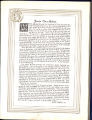
Junior Class History
WHILE glancing through the Ambrosian of 1916 the other day,
twenty-seven familiar faces, the Academic graduates of that
year, smiled at me from its pages and conjured up old memories that would, no doubt, soon disappear into the haze of
history were it not for such a book as this to bring them now
and then to the light. Then I read the Class Prophecy by
Mark Healy. Though Mark's vision was keen at times, I realized what a
precarious thing it is to be a prophet in these days, when history refuses
to be made in an orderly and logical way. The War has made it so. Mars
has already marshalled into service five of our classmates. Perhaps even
before this appears in print he will have claimed others of the twenty-
seven for himself. Of the rest of the twenty-seven, eight are continuing
their studies in different branches at various universities, and five are helping Uncle Sam get food to supply the boys "over there."
When the halls of St. Ambrose again echoed and reechoed with student
voices in September of the year 1916, only eleven of those who had graduated in June returned to form the College Freshman Class. Fortune sent
us a new man, a gentleman from Keokuk, whose ability with the pen immediately won him a place on the Faculty as professor of penmanship. Then
a prodigal Ambrosian, after wandering Ulysses-like for two years, returned
to continue his College Course with us. Then, after waiting some weeks for
recruits to fill up the vacant places, a chap with a buoyant spirit and lively
Irish wit came all the way from Boston to be one of us. So our class grew
in its Freshman year.
You notice ere this, perhaps, the conspicuous silence regarding our
achievements. This is due, partly to the common conviction of the class
that deeds and not words should characterize real worth, and partly to the
fact that deeply sensed altruistic motives prevent our saying aught that
would invite even a glance of jealousy from our contemporaries. There is,
moreover, a strong bond of kinship between us and the present Seniors,
who now claim among them some who were once with us. But if it is permitted to cite some evidences of our ability, energy, and efficiency, we might
mention the organization of the Social Literary Club in 1916. It was an
innovation for an individual class to conduct its own debating club. That
it was a happy innovation is proven by the fact that our initiative has been
followed by our successors.
This year only seven of our classmen returned. Hardly had two weeks
passed by when a meeting was called, and the class officers were chosen.
Resolutions were adopted to waken class enthusiasm. That these resolutions were effective has been shown by the work of the Junior Collegiate
men this year. Not only have they held their own in the class room, but in
music, dramatics, and oratory they have shown talent and ability of high
order. They have given three members to the Ambrosian Staff, and on the
campus and in the field they have not been laggards. Next year they intend
to press onward to the mark with increased vigor; they hope to make their
last year the "biggest and best" of their college history.
JOHN GERWE, '19.
WHILE glancing through the Ambrosian of 1916 the other day,
twenty-seven familiar faces, the Academic graduates of that
year, smiled at me from its pages and conjured up old memories that would, no doubt, soon disappear into the haze of
history were it not for such a book as this to bring them now
and then to the light. Then I read the Class Prophecy by
Mark Healy. Though Mark's vision was keen at times, I realized what a
precarious thing it is to be a prophet in these days, when history refuses
to be made in an orderly and logical way. The War has made it so. Mars
has already marshalled into service five of our classmates. Perhaps even
before this appears in print he will have claimed others of the twenty-
seven for himself. Of the rest of the twenty-seven, eight are continuing
their studies in different branches at various universities, and five are helping Uncle Sam get food to supply the boys "over there."
When the halls of St. Ambrose again echoed and reechoed with student
voices in September of the year 1916, only eleven of those who had graduated in June returned to form the College Freshman Class. Fortune sent
us a new man, a gentleman from Keokuk, whose ability with the pen immediately won him a place on the Faculty as professor of penmanship. Then
a prodigal Ambrosian, after wandering Ulysses-like for two years, returned
to continue his College Course with us. Then, after waiting some weeks for
recruits to fill up the vacant places, a chap with a buoyant spirit and lively
Irish wit came all the way from Boston to be one of us. So our class grew
in its Freshman year.
You notice ere this, perhaps, the conspicuous silence regarding our
achievements. This is due, partly to the common conviction of the class
that deeds and not words should characterize real worth, and partly to the
fact that deeply sensed altruistic motives prevent our saying aught that
would invite even a glance of jealousy from our contemporaries. There is,
moreover, a strong bond of kinship between us and the present Seniors,
who now claim among them some who were once with us. But if it is permitted to cite some evidences of our ability, energy, and efficiency, we might
mention the organization of the Social Literary Club in 1916. It was an
innovation for an individual class to conduct its own debating club. That
it was a happy innovation is proven by the fact that our initiative has been
followed by our successors.
This year only seven of our classmen returned. Hardly had two weeks
passed by when a meeting was called, and the class officers were chosen.
Resolutions were adopted to waken class enthusiasm. That these resolutions were effective has been shown by the work of the Junior Collegiate
men this year. Not only have they held their own in the class room, but in
music, dramatics, and oratory they have shown talent and ability of high
order. They have given three members to the Ambrosian Staff, and on the
campus and in the field they have not been laggards. Next year they intend
to press onward to the mark with increased vigor; they hope to make their
last year the "biggest and best" of their college history.
JOHN GERWE, '19.
Publisher
Wagner's Printery
Date
1918
Rights
St. Ambrose University, 518 W. Locust St., Davenport, IA 52803
Identifier
http://cdm16810.contentdm.oclc.org/cdm/ref/collection/p16810coll2/id/6734