
Restorations and Additions
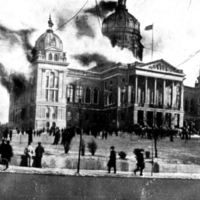
The Fire of 1904
In 1902, in an attempt to modernize and complete the building, a third Capitol Commission was created. As work proceeded, a disastrous fire in the north wing on January 4, 1904, presumably started by a workman's candle, damaged the House Chamber, Supreme Court Chamber, and other offices. The commission restored the building, purchased paintings and mosaics and completed the decorative painting in the corridors. These expenditures raised the total cost of the Capitol building to $3,296,256.
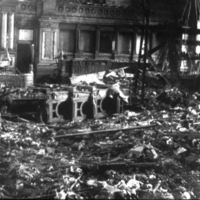
Damage to the House Chambers
The damage to the House of Representatives Chamber following the fire was immense. With the Legislature due to convene a week after the fire, conferences were immediately held to determine what could be done to repair the House Chamber. When the House convened, it was decided to use the Chamber anyway. Tarps were hung to cover holes in the ceiling, and the Session proceeded in spite of heavy soot that necessitated daily baths for House members.
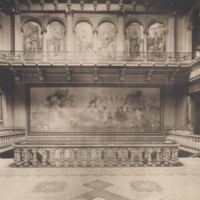
Restoration Begins
In 1904, when fire swept through the areas that now house the Supreme Court and Iowa House of Representatives, major restoration was performed and documented. Extending the full width of the east wall over the staircase is the great mural painting, "Westward," an idealized representation of the coming of the people who made Iowa. This was completed as part of the 1904 decoration.
On the upper floor level above the "Westward" painting are six mosaics in arched panels depicting Defense, Charities, the Executive, the Legislative, the Judiciary, and Education. These were made in Venice from small pieces of colored stone, according to designs by Frederick Dielman of New York, who also designed the mosaic panels, Law and History, in the Congressional Library.
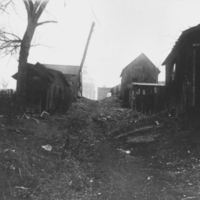
New Monuments, More Land
The State held some additional land but not necessarily land adjacent to the Capitol. In 1909, legislation was passed, and in 1913, the Thirty-Fifth General Assembly enacted controversial legislation to acquire additional land. A commission was formed to locate a purposed monument honoring the long-serving U.S. Senator William B. Allison. E.L. Masqueray was hired as the architect expert focusing on the selection of a proper site for the proposed Allison Memorial. Masqueray’s plan detailed the placement of buildings and potential monuments. Growth of the Capitol Complex, as known today, began.